Severe Public Health Risk
Toxic particulate matter (PM₂.₅) blankets Southeast Asian cities, causing spikes in acute respiratory infections, cardiovascular strain, and millions of lost work hours.
Permanent Solution to ASEAN Haze
For decades, Indonesia, Malaysia, and Singapore have choked on recurring seasonal haze from agricultural waste burning, while cities pile up ever-growing mountains of municipal waste they cannot get rid of. Blue Systems combines both into one feedstock and converts it into high-value GreenSynGas™—ending the burn, shrinking the landfill, and fueling the future.
The Recurring Crisis
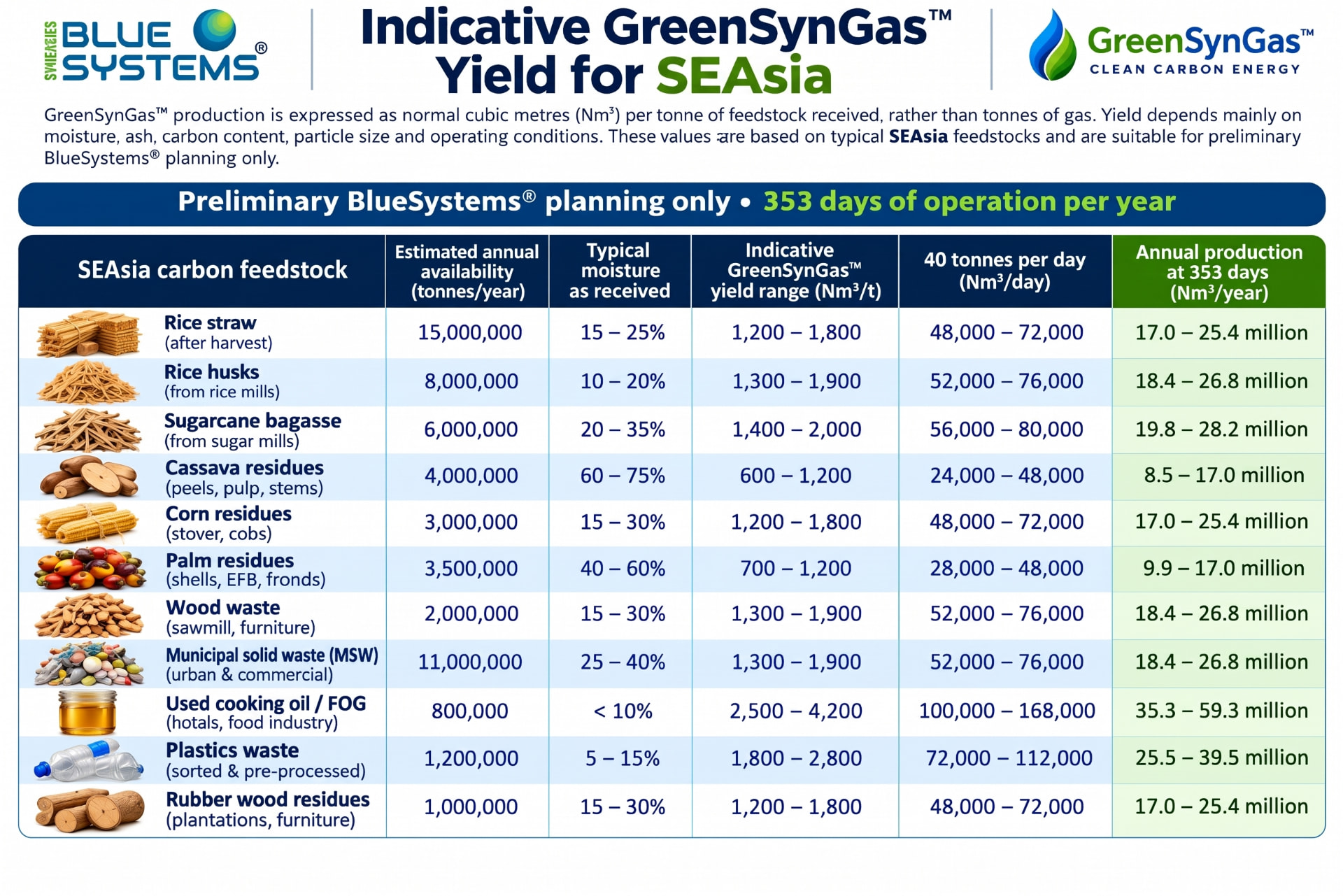
Every dry season, millions of tonnes of agricultural residues—palm oil empty fruit bunches, rice straw, and bagasse—are openly burned across Indonesia and Malaysia, triggering severe regional smog across Singapore and neighbors. At the same time, the region's cities are burying a second crisis: mountains of municipal waste that grow taller every year, with nowhere left to put them.
Toxic particulate matter (PM₂.₅) blankets Southeast Asian cities, causing spikes in acute respiratory infections, cardiovascular strain, and millions of lost work hours.
Regional economies suffer billions in tourism losses, grounded flights, agricultural degradation, and emergency healthcare expenditures year after year.
Treating farm waste as a disposal nuisance rather than a high-value resource means throwing away billions in clean energy potential annually.
Two Problems, One Feedstock
Open burning and ever-growing landfill mounds are the same failure seen twice: a usable resource treated as garbage. Blue Systems brings both streams into one process, so the waste that chokes the air and the waste that buries the land becomes a single mixed feedstock for clean energy and essential commodities.
Cities generate municipal solid waste faster than landfills can be built. The mounds grow year after year—leaching, venting methane and inviting open burning—while disposal costs climb with every tonne buried.
Palm oil empty fruit bunches, rice straw and bagasse are stockpiled or openly burned each dry season, turning a valuable resource into regional haze and lost revenue.
Municipal Waste+Agricultural ResiduesGreenSynGas™
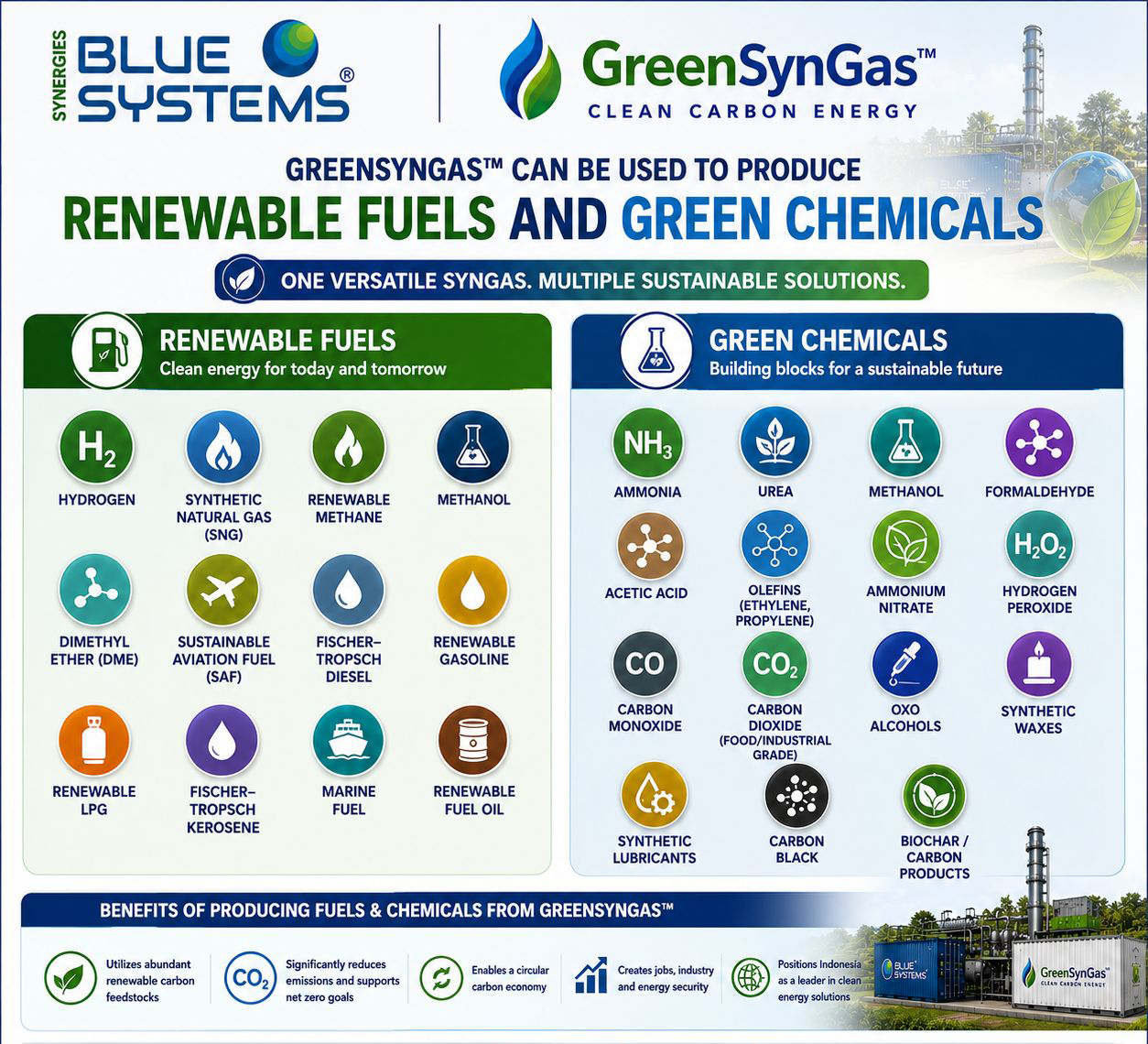
Steam reforming converts the combined feedstock into clean synthesis gas for electricity, green ammonia and fertilizers—with no open burning and no flu-gas. The landfill mound stops growing, the fields stop burning, and the tonne that once cost money to dispose of now earns its keep.
The Blue Systems Cure
Instead of open burning or landfilling, Blue Systems deploys proprietary high-temperature steam reforming modules directly at agricultural clusters and city waste hubs. Farming residues and municipal waste become clean, premium GreenSynGas™, with a potential energy value of US$400 per tonne.
Advanced thermochemical decomposition without harmful dioxin or particulate emissions.
Modular units installed near plantations and city waste hubs to eliminate costly and polluting long-distance hauling.
Syngas is piped directly into power generation, hydrogen production, or green chemical synthesis.
Agricultural Waste
Illustrative estimates based on US$400 per processed tonne of dry agricultural waste and 1.85 tonnes of avoided CO₂ per tonne. Actual yields, energy value, and emissions reductions depend on feedstock and project conditions; these are not guaranteed returns.
The History
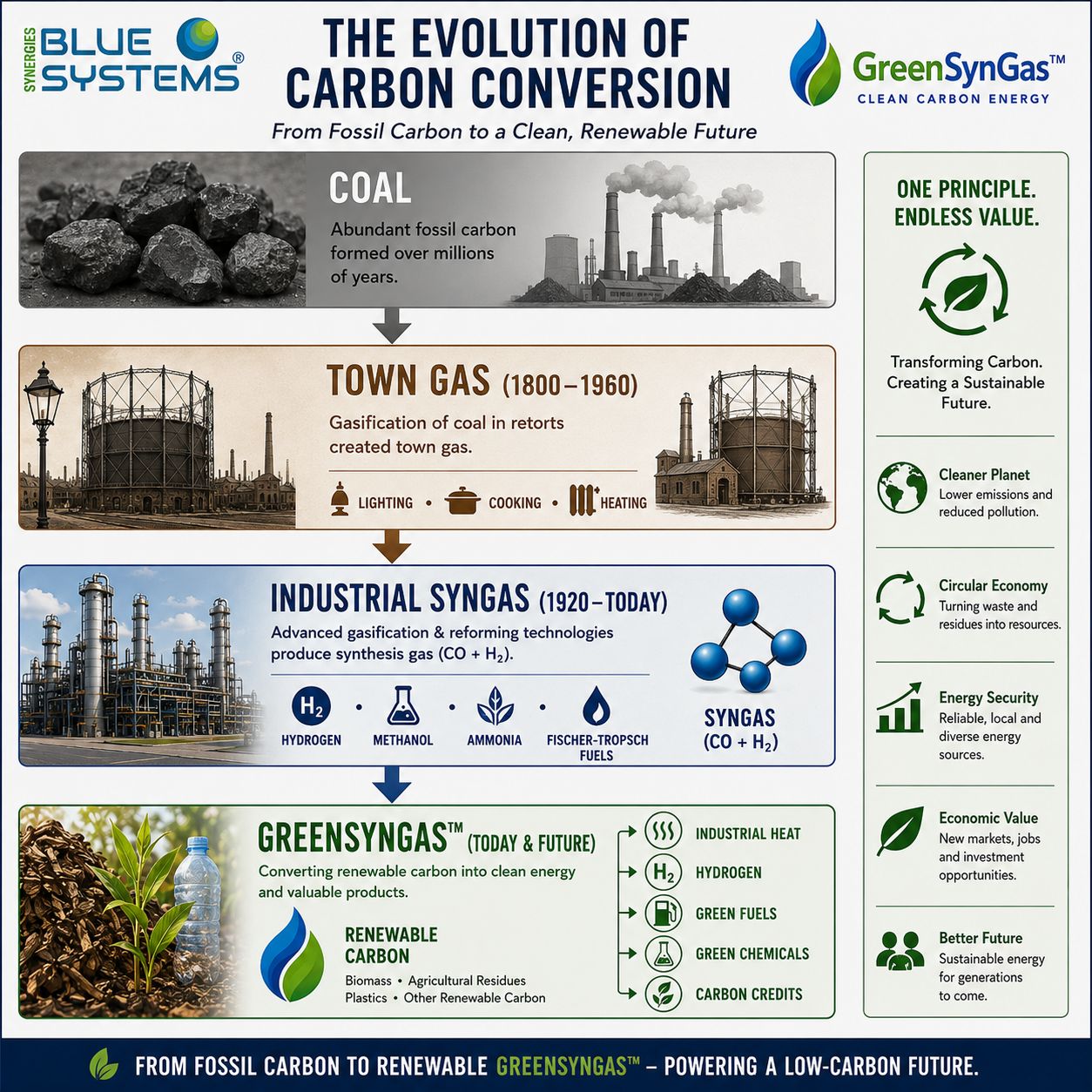
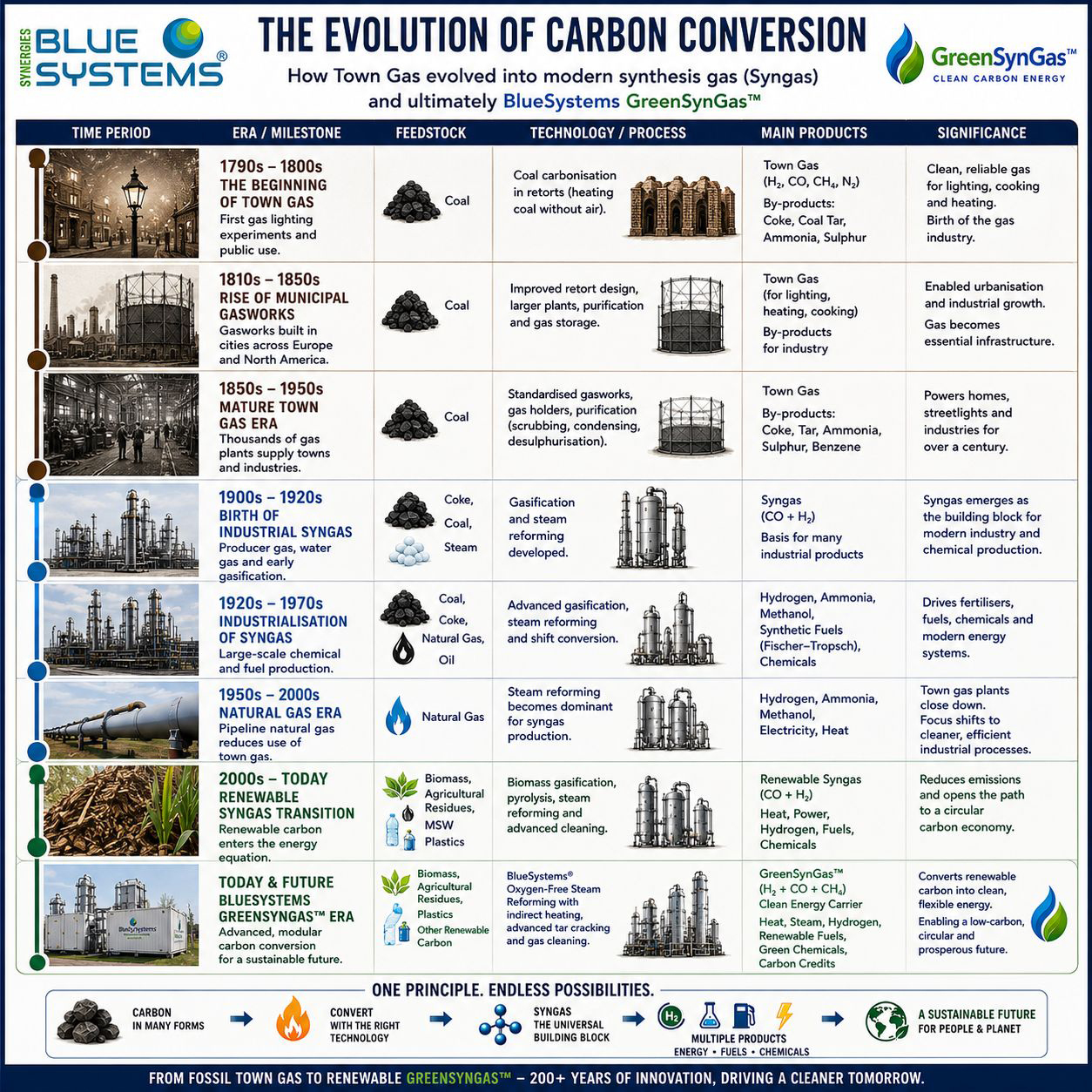
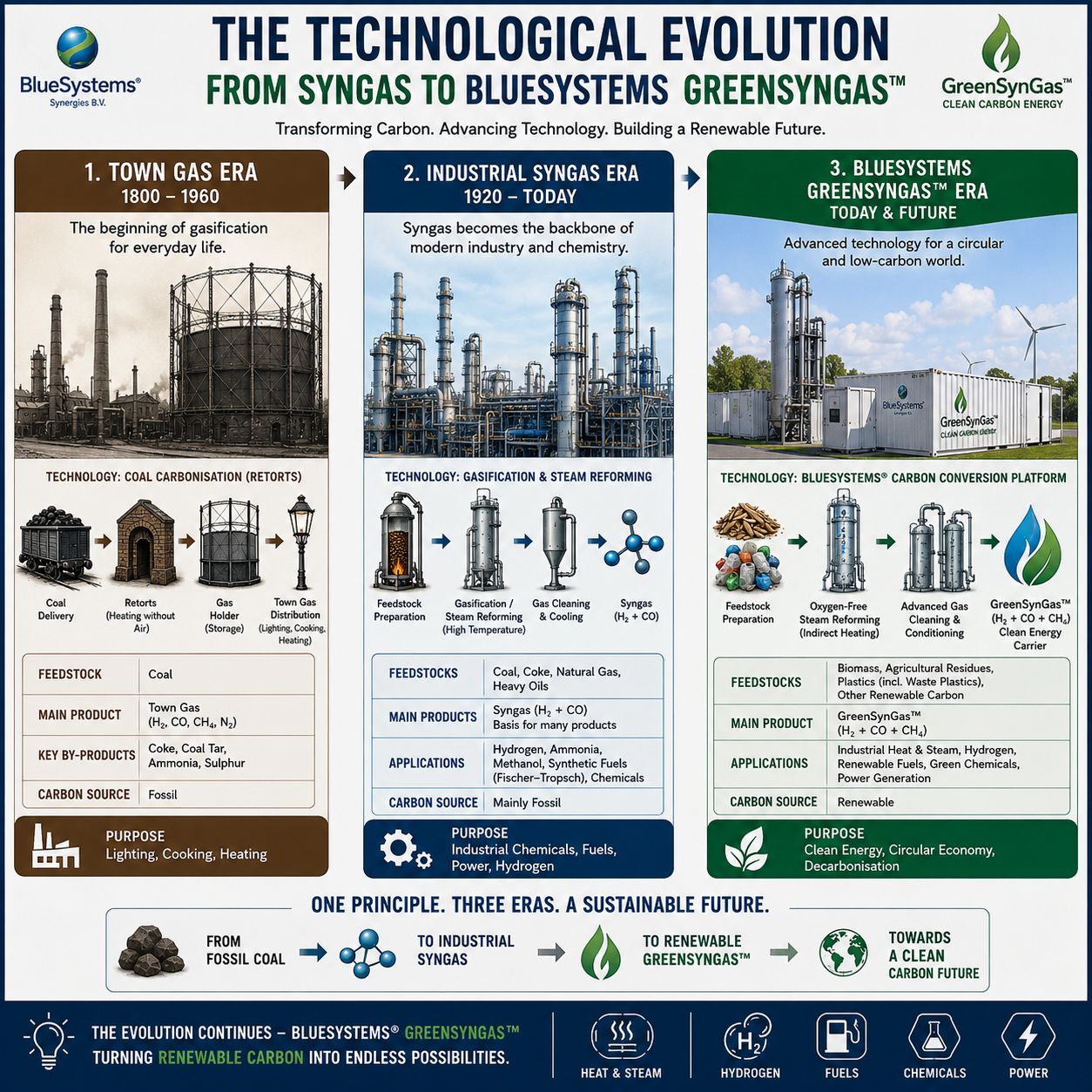
Steam reforming did not appear out of nowhere. It is the latest chapter in a story that begins with the coal gasworks of the late 1700s and runs through town gas, industrial synthesis gas and on to renewable GreenSynGas™.
Panel 1 of 3
From Town Gas to GreenSynGas™
Making a useful gas out of carbon-rich material is not a new idea — it has been done for two centuries, each era with its own feedstock, its own technology and its own purpose. This poster sets the three eras side by side.
BlueSystems® Configurations
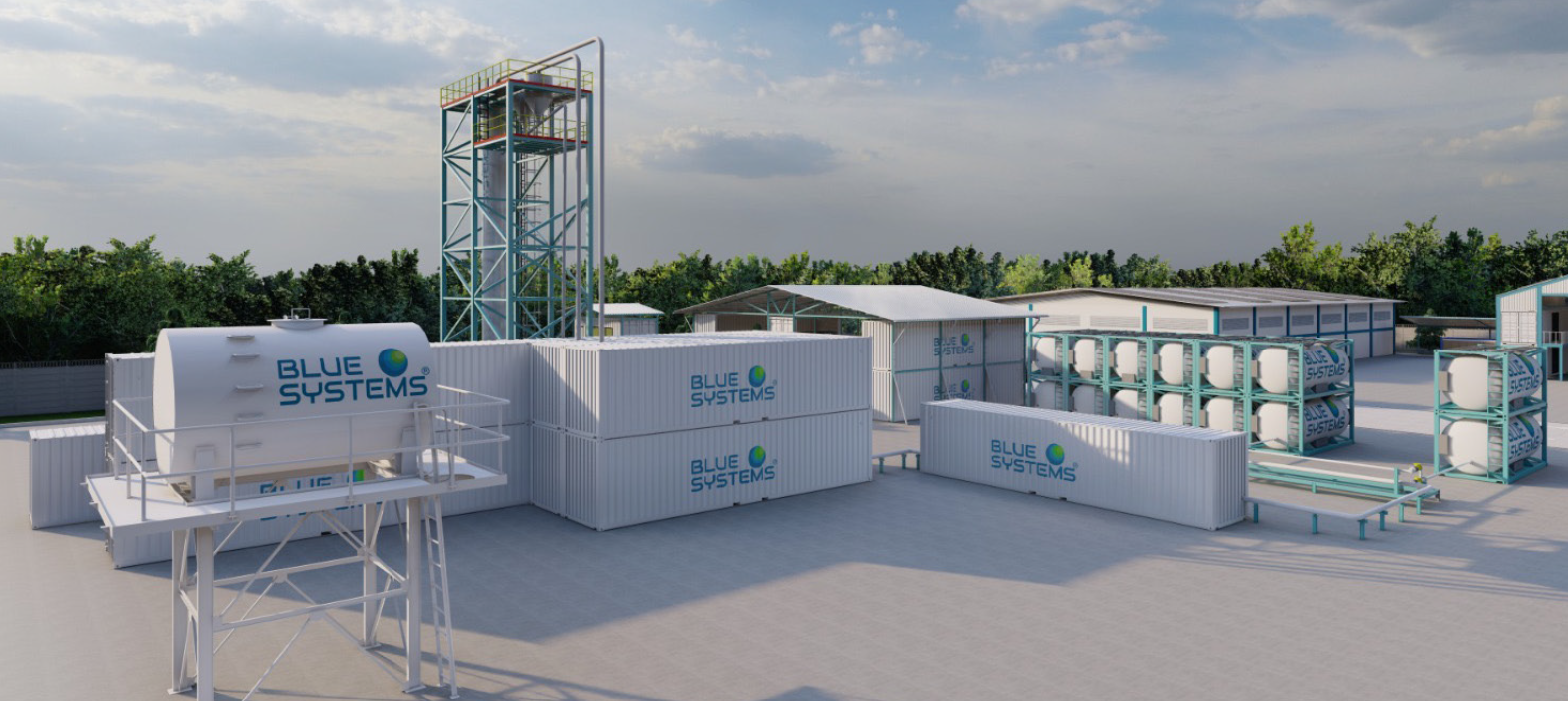
Space Requirement: A 50-tonne per day processing plant requires approximately 1 acre (roughly the size of a football pitch).
Gas Offtake & Blending: The GreenSynGas™ we produce can be injected into conventional gas pipelines, blended at 10–15% with natural gas, and utilized within existing infrastructure for power generation.
Plant Location: While proximity to either the waste feedstock source or the power user is advantageous, it is not strictly essential.
Energy Conversion Support: If your project requires assistance with energy conversion, we can fully support you with that as well.
Unmatched Economics
By making waste collection more profitable than open burning, Blue Systems aligns environmental stewardship with commercial returns.
US$400
Transforms zero-value agricultural debris and buried municipal waste into high-grade synthesis gas suitable for power grids and industrial chemical feedstocks.
Zero Burn
Plantation owners, smallholders and municipalities earn immediate revenue rather than paying labor costs for open-air burning or landfilling.
3 Countries
Securing clean air across Indonesia and Malaysia as source markets, and Singapore as the regional clean energy market hub.
Socio-Economic Impact & Community Creation in Rural Indonesia
Thousands of Potential Jobs
Mobilizing local workers in rural Indonesia to earn income collecting, organizing and sorting municipal waste alongside agricultural residues from surrounding villages and plantations.
Transforming zero-value municipal garbage and agricultural debris into a unified, income-generating supply chain for rural communities.
High-Value Technical Jobs
Creating opportunities for local Indonesian engineers, technicians and operational staff to run high-temperature steam reforming plants processing both municipal and agricultural streams.
Developing local technical expertise and skilled careers in advanced green energy infrastructure, bringing long-term employment opportunities closer to rural communities.
New Regional Industry
Building regional ethanol and methane distribution networks and transport logistics in rural Indonesia, derived from mixed municipal and agricultural feedstock.
Directing the produced ethanol and methane toward local and domestic consumption, reducing reliance on expensive imported or traditional energy alternatives.
Creating potential for thousands of additional jobs across regional deployments in clean energy distribution, safety compliance and commercial management.
Employment opportunities depend on the number and scale of deployments, local feedstock supply and downstream demand. Job totals describe regional potential, not guaranteed employment at an individual plant.
Border-Free Clean Air
Haze does not respect borders. Neither does our solution. Blue Systems connects agricultural hubs to regional green energy demand.
Source Hub
Processing massive volumes of palm oil empty fruit bunches (EFB) and agricultural residues directly at plantation origins across Sumatra and Kalimantan.
Potential Waste: 45M Tonnes/yr
Primary Generation
Processing Hub
Integrating steam reforming units into Peninsular and East Malaysian palm estates to convert biomass into clean industrial hydrogen and syngas.
Potential Waste: 20M Tonnes/yr
Industrial Reforming
Financial & Tech Hub
Serving as the green financing, carbon credit verification, and regional clean energy offtake headquarters, with the goal of crystal-clear air for citizens.
Target: Zero Haze Days
Financing & Markets
Value Proposition
From a single tonne of waste to a complete modular plant: the conversion yield, the unit economics and the financial terms behind the Blue Systems offer.
The Conversion Engine
Input Baseline
1 Ton
of waste
Converted Yield
1,500 Nm³
GreenSynGas™ containing 65% hydrogen (H₂)
Calorific Equivalence
300 kg
of natural gas
Market Value Generated
US$400
Equivalent market value per tonne of waste processed
Unit Economics
Daily Capacity
50
Tons Per Day
Per medium modular unit
Capital Expenditure
US$11M
Total CAPEX
Plug & play containerized setup
Operating Expense
US$1M
Per Annum (p/a)
Optimized low running overhead
Return on Investment
~3 Yrs
ROI Potential
Exceptional financial payback
Financial Assurance
Through our dedicated financial partner, all Letters of Credit (LCs) are fully covered, eliminating upfront financial exposure for the client. Your capital remains protected—full payment is only required once the project is successfully completed, commissioned, and fully operational.
Conversion yields, unit specifications and returns are indicative planning estimates for a medium modular unit; actual results depend on feedstock, site and contract conditions and are not guaranteed returns.
Apply for Deployment
Interested parties can download the Blue Systems W2E Facility Deployment Application (November 2026), complete and sign the form, and email it to Daniel at daniel@quettil.com to start the review process.
Save the Blue Systems W2E Facility Deployment Application (November 2026) as a PDF.
Fill in your site, feedstock and capacity details, then sign the form.
Send the signed form to daniel@quettil.com and the review process begins.